The story in 5 beats
- Rom collapses
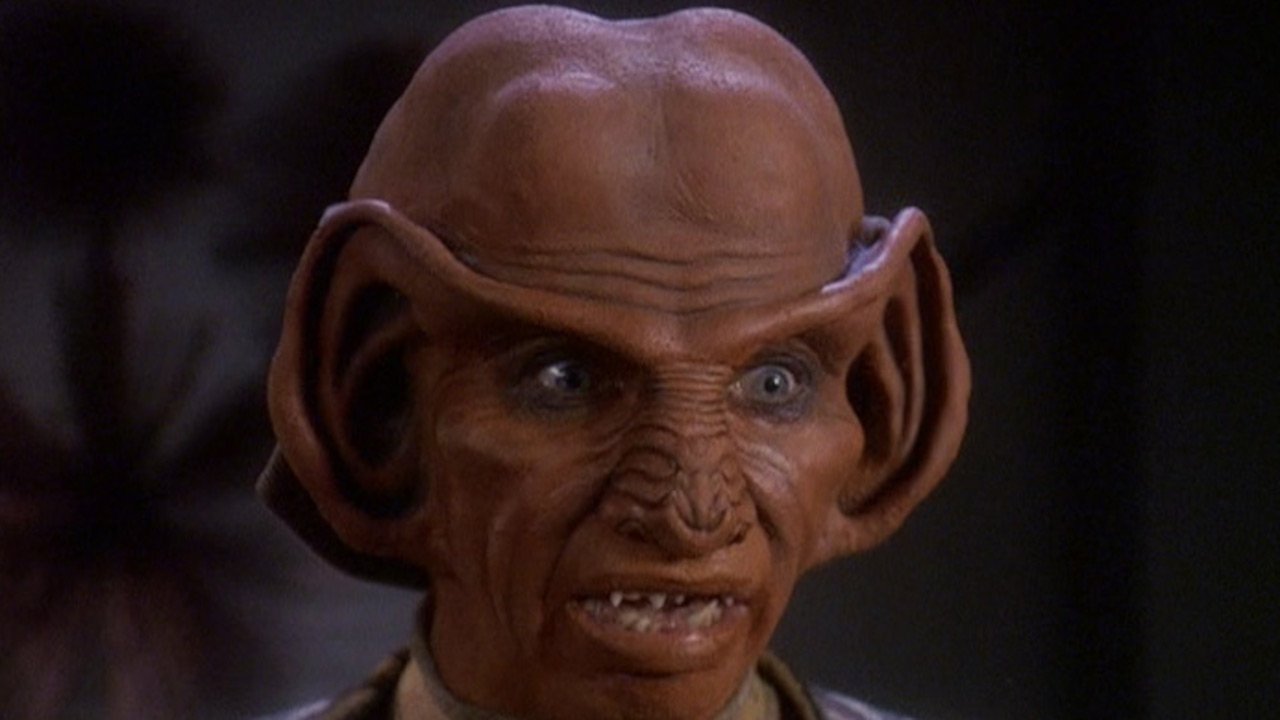
Rom collapses at work with an ear infection. Bashir is appalled that Quark gives his staff no sick leave and suggests, half joking, that Rom form a union. Ferengi law forbids it.
- The Guild is born
A Bajoran religious observance empties the bar, so Quark cuts pay. Rom calls a secret meeting, fired up by O'Brien's tales of his union-leader ancestor in the 1902 coal strike.
- On strike
Quark laughs off the demands, so the staff walk out and the station boycotts the bar. Rom turns down a bribe with a line from Marx: "Workers of the world, unite!"
The Commerce AuthoritySpoiler · tap to reveal
Brunt crashes a union meeting and threatens the workers with ruin. Rom rallies them again. Then Brunt has his thugs beat up Quark as an example.
Settling upSpoiler · tap to reveal
From his biobed, Quark offers to meet the demands in secret if the union disbands and lets him look like the winner. Rom agrees, then quits to be a station repair technician.
Why it still matters
Many of the Ferengi episodes were Deep Space Nine's comedies, and this one is also an argument. Rom, the Ferengi least likely to stand up to anybody, organizes his brother's staff and quotes The Communist Manifesto at him. Manu Saadia, in his 2016 book Trekonomics, saw Rom as central to the turning point of the show's whole Ferengi arc: "Rom finally breaks free from the ideological constrains of his own culture, centuries upon centuries of traditions and learned behaviors. He discovers that he can actually do that, and that it does not kill him."
Robert Hewitt Wolfe and Ira Steven Behr wrote the teleplay from a story by Barbara J. Lee and Jenifer A. Lee, and LeVar Burton directed. It brings back Jeffrey Combs as Liquidator Brunt of the Ferengi Commerce Authority, who first turned up in "Family Business," and gives Worf, new to the station this season, a subplot about how much he hates living there.
Critics split. Keith DeCandido of Tor.com gave it 9 out of 10, and io9 put it on its 2020 list of the series' must-watch episodes. Zack Handlen of The A.V. Club found it "fun to watch" even though the plot has little tension. Michelle Erica Green of TrekNation liked scenes for Rom, Worf and O'Brien but wasn't taken with either story, adding, "I've never been completely sure of the point of having Ferengi on DS9."
A paying customer
The strike ends the Ferengi way, with a deal nobody else is allowed to know about. Quark pays the higher wages and the union officially goes away, and Rom pretends that Quark has won. The more lasting change is Rom's. Once everyone is back at work, he makes up with Quark and leaves for a job as a junior repair technician, having worked out that he does better outside his brother's authority. He promises to keep coming to the bar, as a paying customer.
It fits Saadia's reading of Rom: he finds he can leave the life his culture and his brother laid out for him, and nothing terrible happens. Meanwhile Worf, after a brawl with O'Brien and Bashir over the strike, moves his quarters onto the Defiant. Dax gives him a collection of Klingon operas and warns him he will have to get used to the station sooner or later.
Challenge the DNA
Did the strike succeed?
Or skip ahead to our reading
It worked, quietly. The deal is pure Ferengi. Rom's own change is the bigger result.
Behind the scenes
- Robert Hewitt Wolfe co-wrote several of the show's Ferengi comedies, including "Family Business" and "Little Green Men," alongside dramas such as "The Wire."
- LeVar Burton directed. Earlier in the fourth season he had directed "The Sword of Kahless."
- Saadia's Trekonomics points to Rom forming a union and quoting the Manifesto word for word as the clearest sign of how far Rom had come.
- Uwe Meyer, in a 2008 German-language collection of essays on Star Trek's politics, wrote that Rom draws on human ideology, both communist and that of American trade unions, and that he comes across as likeable partly because Federation values have rubbed off on him.
- In 2013 Wired's Graeme McMillan called Rom arguably the best character in Deep Space Nine, and praised Max Grodénchik for bringing him to life.
- It drew a Nielsen rating of 6.7, according to TrekNation's figures.
The thread
Ferengi law, a Marxist slogan and a century of real picket lines, all inside one bar.
Came before
Shares DNA with
DNA strand
Sci-Fi Played for Laughs
It's a workplace comedy with big ears, built on the joke that the meekest Ferengi on the station is the one who reads Marx. The laughs carry a real labor story, down to the bribe, the boycott and the company enforcer.
Every great sci-fi story is built from a handful of strands like this one. Each strand page explains how it works and traces it across shows, books and films.
If this one stayed with you
Where to go next, and why.
Watch · Film
Norma Rae (1979)
Sally Field won an Oscar as a mill worker who decides to organize. It's the same story with the jokes taken out and the stakes left in.
Watch · Star Trek: DS9 S3
"Family Business" (1995)
Brunt's first visit and a trip to the Ferengi homeworld, with Quark and Rom's mother breaking the rules long before Rom does.
Read · Nonfiction
Trekonomics by Manu Saadia
An economist's book about how a world without money would work, with a whole argument about the Ferengi and why Rom matters to it.
Read · Pamphlet
The Communist Manifesto by Marx and Engels
Short enough to read in an evening, and you'll recognize the line Rom borrows when Quark tries to buy him off.
Your next episode
Three directions to go from here, all on Sci-Fi DNA.
More of this feeling
Family Business
Star Trek: Deep Space Nine
Ferengi family politics and a fight over profit.
Same question, different answer
The Cloud Minders
Star Trek
What happens when the workers stop accepting their place?
Something completely different
Accession
Star Trek: Deep Space Nine
A poet from the past claims to be the Emissary.
Sources
- “Bar Association (Star Trek: Deep Space Nine),” Wikipedia
- “List of Star Trek: Deep Space Nine episodes,” Wikipedia
- “Rom (Star Trek),” Wikipedia
- “Robert Hewitt Wolfe,” Wikipedia
- “Star Trek: Deep Space Nine Rewatch: "Bar Association" (Keith R. A. DeCandido, 2014),” Tor.com
- “Star Trek: Deep Space Nine: "Bar Association"/"Accession" (Zack Handlen, 2013),” The A.V. Club
- “Bar Association (Michelle Erica Green, 2004),” TrekNation
- “Norma Rae,” Wikipedia