
More from the episode

The story in 5 beats
- Genius toaster
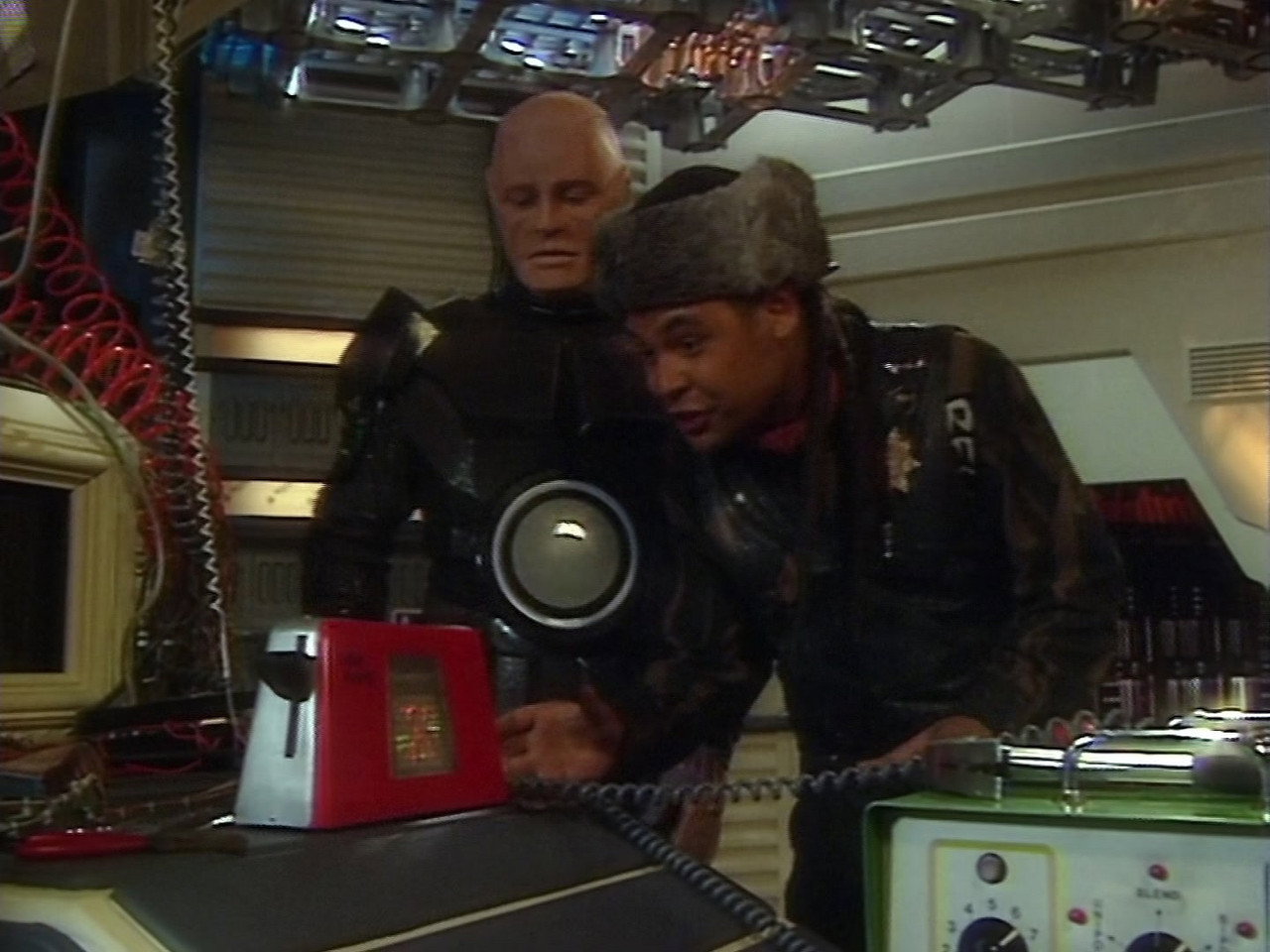
Kryten tries intelligence compression on Talkie Toaster, then on Holly. Her IQ soars, but she now has minutes to live, so she switches herself off.
- No power
With Holly off, Red Dwarf is dark. The crew live on backup power, hike to the cargo decks and pedal to make electricity.
- Time leaks
On the way back from the cargo decks, Kryten and Rimmer hit a space-time anomaly. Kryten works out that a white hole is nearby, spewing out time.
Planet poolSpoiler · tap to reveal
Holly's plan is to knock a planet into the white hole with a nuclear blast. Lister insists on taking the shot himself, like a pool player.
Never happenedSpoiler · tap to reveal
His trick shot works, time snaps back, and nobody remembers any of it. Kryten gets one honest sentence in to Rimmer first.
Why it still matters
Holly, the ship's computer, is going senile, so Kryten tries a fix called intelligence compression. He tests it on Talkie Toaster first, the most annoying kitchen appliance in the galaxy, and then on Holly. Her IQ more than doubles. The catch is a miscalculation that leaves her with about three minutes to live, and she shuts herself down, taking the ship's main power with her.
What follows is two episodes' worth of ideas squeezed into one. There's the comedy of a powerless ship, with the crew pedalling to make electricity. Then a white hole, the opposite of a black hole, starts spitting time back into the universe and scrambling it around the ship. And when a fix finally turns up, it depends on Lister, whose physics training is a pub pool table.
Fans have long ranked it near the top of Series IV, and it shows how far the show had grown. The sci-fi ideas are big, and the jokes still come from character.
The shot nobody remembers
Holly is switched back on just long enough to give them an answer: set off a thermonuclear device near a star so the blast pushes a planet into the mouth of the white hole and plugs it. She has the calculations. Lister has a cue-ball eye and no faith in maths, and he wants to aim it himself. Rimmer backs the computer. Kryten and the Cat back Lister. Lister plays it as a trick shot, and it goes in.
Sealing the hole puts time back the way it was before the whole thing started, so the crew forget all of it: the genius Holly, the dark ship, the vote and the shot. Before the reset wipes it, Kryten gets the brief satisfaction of telling Rimmer what he really thinks of him.
Behind the scenes
- It was the last script written for Series IV. An earlier version set partly on Garbage World, from the novel Better Than Life, was dropped because its giant cockroaches and big sets were too expensive, and the replacement took a different idea from the same book, turning its black hole into a white hole.
- The official site calls it the only episode based on material that first appeared in the novels.
- Ed Bye is the credited director, but he was at the birth of his second child on the studio night, so former producer Paul Jackson stepped in, uncredited.
- David Ross, the original Kryten from Series II, took over Talkie Toaster's voice from John Lenahan, and found it a lot easier than the Kryten makeup.
- A bald, bespectacled look for the genius Holly was dropped. Hattie Hayridge was filmed against bluescreen so her head could be put into the shots.
- Recorded on 13 December 1990 at Shepperton Studios.
The thread
The novel it came from, other stories where getting smarter or rewinding time comes with a bill, and the toaster's return.
Came before
Shares DNA with
Left its mark on
DNA strand
Time Loops & Timelines
"White Hole" treats time as something that can leak out of a hole in space and get loose around the ship. Then it uses the reset ending as a punchline. The crew save themselves and lose the memory of doing it, which is either the perfect fix or the perfect waste.
Every great sci-fi story is built from a handful of strands like this one. Each strand page explains how it works and traces it across shows, books and films.
If this one stayed with you
Where to go next, and why.
Read · Novel
Better Than Life (1990)
The second Red Dwarf novel, where the idea behind this episode first appeared. The books go darker and stranger than the show could afford to.
Read · Short story
"Flowers for Algernon" (1959)
If Holly's brief brilliance was the part that stuck, this is the serious version: a man made a genius by an experiment, written in his own words.
Watch · TNG S5
"Cause and Effect" (1992)
Another crew stuck in time that keeps folding back on itself, who have to find a way out with almost nothing to go on.
Watch · Film
Groundhog Day (1993)
A whole film of time refusing to behave, and the funniest one. Good company for an episode where the reset is the joke.