
More from the episode
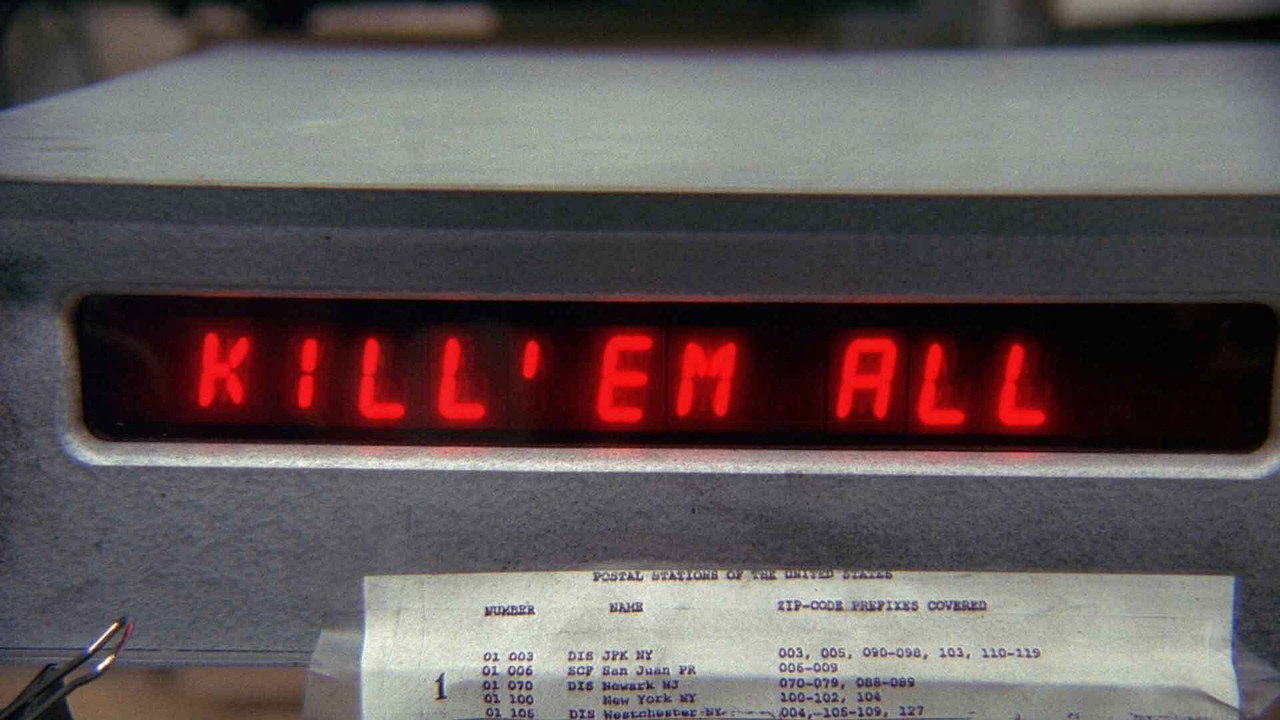

The story in 5 beats
- Laid off
Postal worker Ed Funsch learns he'll be let go at the end of the week. Then the display on his sorting machine reads KILL 'EM ALL.
- No air
A man in a crowded elevator at the civic center sees NO AIR on the floor display, then CAN'T BREATHE, then KILL 'EM ALL. Nobody else in the car sees a thing.
- Twenty-two dead
The sheriff tells Mulder seven other residents have killed 22 people in six months. Each one wrecked an electronic device, and the elevator killer had green residue on his fingers.
An orchard at nightSpoiler · tap to reveal
A crop-dusting helicopter sprays Mulder. In hospital he sees DO IT NOW on the TV and works out that the pesticide, made to frighten insects, leaves people open to messages that feed their worst fears.
The towerSpoiler · tap to reveal
Ed Funsch, whose fear is blood, climbs a clock tower above a blood drive with a rifle and starts shooting. Mulder climbs up after him and overpowers him.
Why it still matters
"Blood" found something frightening in the gadgets of 1994. Chris Carter wanted a story built around digital readouts, and Glen Morgan and James Wong folded that into three ideas they already had: Morgan's own fear of blood, the row over malathion spraying in Southern California, and a loose notion about postal workers. Brian Lowry's official guide says the result turned new technology, fax machines and cell phones included, into something scary. The killers here are neighbours, and the voice telling them to kill comes from the little glowing screens everybody had stopped noticing.
It also gets laughs out of the same material, which is what critics remember. Zack Handlen of The A.V. Club called it memorable "due in no small part to its humor," a story that makes you "snicker even as you shudder," and singled out William Sanderson as the laid-off postal worker. Entertainment Weekly gave it a B+, finding that a "convoluted plot" still "pays off in white-knuckle tension," and Starpulse ranked it tenth among the show's best in 2008. Robert Shearman was cooler in Wanting to Believe, giving it three stars out of five: "minute by minute, there is tons to enjoy," he wrote, though he found the premise "disjointed and not a little frustrating."
All done
Before the tower, Scully's autopsy on Bonnie McRoberts, the woman who went for Mulder with a knife after her microwave told her to, finds signs of phobia, including high adrenaline, and the same residue, which she thinks could act like LSD alongside the body's own chemistry. Mulder comes to believe Franklin is a testing ground for some third party, with the government in on it. Confronted, a city councilman agrees to stop the spraying and to test the townspeople quietly, calling it a cholesterol study. Ed hasn't been tested yet, and when the agents reach his house they find it full of smashed electronics and an empty rifle case.
Once Ed is carried away on a stretcher, Mulder phones Scully to say the case is closed. As he talks, his cell phone display reads ALL DONE, then BYE-BYE. Scully keeps saying his name, and he can't answer. Handlen called it "the punchline" of Mulder's deepest fears: a group so secret that he can never be sure it exists at all.
Challenge the DNA
Is anyone in Franklin responsible for the killings?
Or skip ahead to our reading
Mulder believes the town was a testing ground. The episode leaves the people behind it unseen.
Behind the scenes
- Morgan and Wong based the climax on the 1966 University of Texas tower shooting. Only part of it was shot at the University of British Columbia, because firearms weren't allowed on location there, so the crew built a replica of the clock tower's interior.
- It was the first time Darin Morgan, Glen's brother, worked on an X-Files script; he was brought in to help flesh out the story.
- The Lone Gunmen (Bruce Harwood, Dean Haglund and Tom Braidwood) make their second appearance. They were meant to appear only once, but fans online liked them so much that they came back as recurring characters from this episode on.
- Bonnie McRoberts is played by the adult film actress Ashlyn Gere. Glen Morgan joked that The X-Files was so cutting edge it used a porn star who was still working, a dig at an NYPD Blue episode that had cast the retired Ginger Lynn.
- Les Martin adapted it in 1996 as Fear, a novel for young adults published by HarperCollins.
The thread
Where the Lone Gunmen came from, and other stories of a town driven to violence and messages only some people can see.
Came before
Shares DNA with
DNA strand
Technology Outpaces Ethics
Nobody in Franklin builds a killer robot. The danger rides on appliances people use every day without a second thought, and the episode asks who else might be able to put words on them, and what those words could do to someone already afraid.
Every great sci-fi story is built from a handful of strands like this one. Each strand page explains how it works and traces it across shows, books and films.
If this one stayed with you
Where to go next, and why.
Read · Novel
Cell by Stephen King
A signal sent over the cell phone network turns most of the people who hear it into vicious animals, and a New England artist has to cross the wreckage to reach his son.
Watch · Film
The Signal (2007)
A transmission on every TV and phone in one city sends people into murderous paranoia, told in three parts by three directors.
Watch · Film
They Live (1988)
John Carpenter's drifter puts on a pair of sunglasses and sees the commands hidden in every billboard and magazine.
Your next episode
Three directions to go from here, all on Sci-Fi DNA.
More of this feeling
Shut Up and Dance
Black Mirror
Ordinary people pushed into terrible acts by messages on their screens makes the same nightmare.
Same question, different answer
The Game
Star Trek: The Next Generation
It asks how easily a device can take over the choices people think are their own.

Something completely different
Sleepless
The X-Files
For a different kind of mind game, follow Mulder to a doctor who died of burns from a fire that never happened.
Sources
- “Blood (The X-Files),” Wikipedia
- “The X-Files season 2,” Wikipedia
- “The Crazies (1973 film),” Wikipedia
- “Videodrome,” Wikipedia
- “Pontypool (film),” Wikipedia
- “Cell (novel),” Wikipedia
- Zack Handlen, “Little Green Men/The Host/Blood,” The A.V. Club, 2008
- “X Cyclopedia: The Ultimate Episode Guide, Season 2,” Entertainment Weekly, 1996