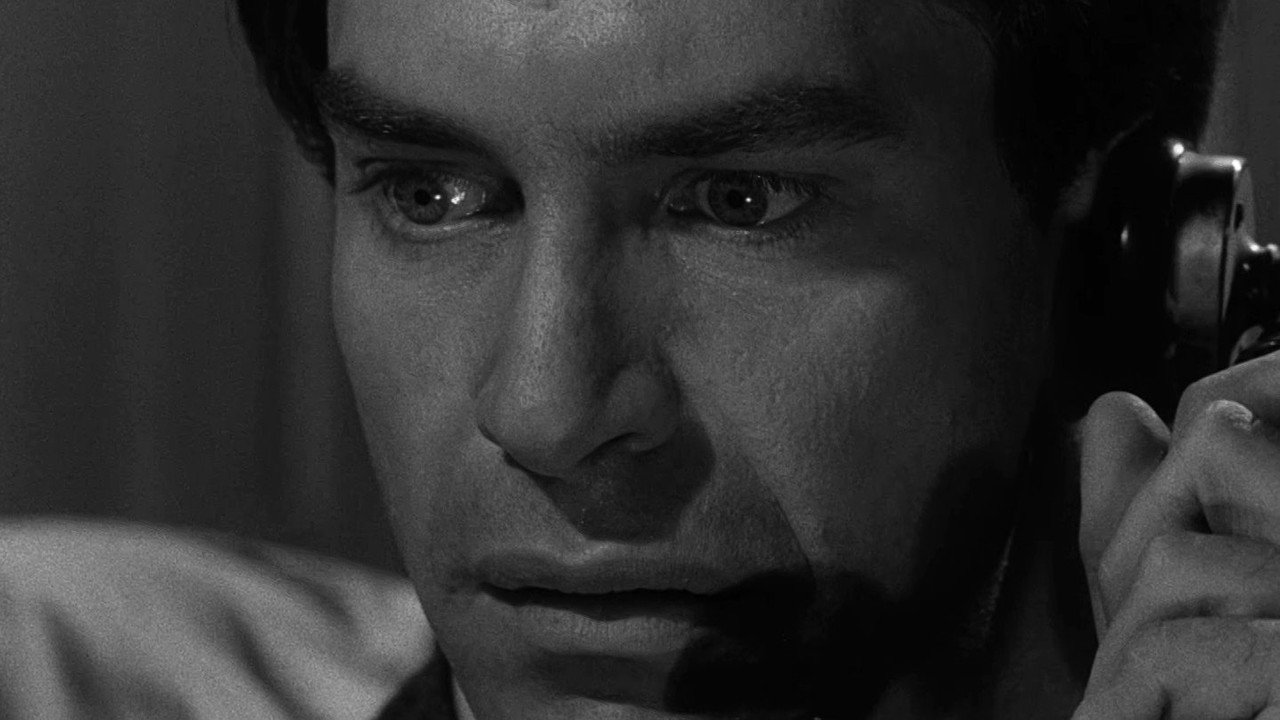
More from the episode

The story in 5 beats
- The room
Kuchenko waits in a cheap hotel for his escape. Across the way, Vassiloff and his gunman Boris are watching his window.
- A visit
Vassiloff pays a call and drugs him. Kuchenko wakes up to a recorded message.
- Three hours
Something in the room is booby-trapped. Find it and he walks free. Leave, or turn out the light, and Boris shoots.
The telephoneSpoiler · tap to reveal
Time is nearly up when the phone rings. Kuchenko doesn't answer, and runs for the door under fire.
A call from the airportSpoiler · tap to reveal
Vassiloff and Boris come back to tidy up. The phone rings again.
Why it still matters
There's nothing supernatural in it, no ghosts or aliens or deals with the devil, just a Cold War cat-and-mouse game that The A.V. Club's Zack Handlen said could easily have turned up on Alfred Hitchcock Presents. It's one of the very few Twilight Zone episodes with no fantasy element at all, and it shows how far the show's twist machinery could run on suspense alone.
Martin Landau plays Major Ivan Kuchenko, an escaped political prisoner trying to get out of a neutral country alive. John van Dreelen is Commissar Vassiloff, an urbane, eloquent killer who prefers a puzzle to a bullet. With three speaking parts and two sets, Richard Donner keeps the camera tight around Kuchenko so the hotel room feels like a cage.
It's a late-season Serling script, and Landau later said the writer looked tired that year. The premise is a terrific one, even if critics have picked at how the ending gets there.
Who answers the phone
Vassiloff has told Boris the truth that Kuchenko is never given: the bomb is in the telephone, and it goes off only when someone picks up an incoming call. With about ten minutes left, Vassiloff rings the room to finish the game. Kuchenko hesitates, leaves the receiver alone and bolts, and Boris's shots miss him.
The two hunters return to the room to clean up after their failure. The phone rings, Boris answers it, and the explosion kills them both. The call came from Kuchenko, in a phone booth at the airport, on his way to a flight to New York. Serling's closing narration credits his escape to ingenuity. Marc Scott Zicree, in The Twilight Zone Companion, thought the finale absurd, since a trained agent walks back into a room with a live bomb in it. That's fair, though the comeback still works.
Behind the scenes
- Serling began the script in 1961 under the title "Method of Execution." That draft had several explosives and an open-ended finish; he dropped both when he rewrote it for the fifth season.
- It's one of the few episodes of the original series with no supernatural or science-fiction element.
- It was Martin Landau's second Twilight Zone, after the first-season western "Mr. Denton on Doomsday." He recalled that Serling "looked tired, felt tired" and was worn down by fighting networks and sponsors to keep the show going. Landau also appeared in "The Beacon" for the 1980s revival.
- Two years later Landau was Rollin Hand, the master of disguise, in the first three seasons of Mission: Impossible. He won an Oscar for playing Bela Lugosi in Ed Wood (1994).
- Richard Donner directed, two weeks after he directed "Sounds and Silences." He went on to The Omen, Superman and The Goonies.
- The 1999 film Payback uses a similar booby-trap device and a similar twist.
The thread
Locked rooms, ticking clocks and killers who would rather play a game than pull a trigger.
Came before
Shares DNA with
DNA strand
The Cruel Twist
Vassiloff builds the perfect trap and makes the overconfident villain's classic mistake of forgetting it works on anyone. There's no magic in it; the hunter's own cleverness is what kills him.
Every great sci-fi story is built from a handful of strands like this one. Each strand page explains how it works and traces it across shows, books and films.
If this one stayed with you
Where to go next, and why.
Watch · Twilight Zone S1
"Mr. Denton on Doomsday"
Landau's first Twilight Zone, as a swaggering town bully. It's fun to see him on the other side of the menace.
Watch · Film
Phone Booth (2002)
If the ringing phone was the best part for you, here's a whole film built on one call and one sniper.
Watch · TV series
Mission: Impossible (1966)
Landau again, two years on, now the one designing elaborate traps for Cold War villains.
Read · Novel
The Spy Who Came in from the Cold by John le Carré
Published the year before this aired. If Kuchenko's world of defectors and patient killers caught you, le Carré has it in full, with no comeback ending to save anyone.
Sources
- “The Jeopardy Room,” Wikipedia
- “The Twilight Zone (1959 TV series) season 5,” Wikipedia
- Zack Handlen, “The Twilight Zone: "The Jeopardy Room"/"Stopover In A Quiet Town",” The A.V. Club
- “Rod Serling's Twilight Zone Exhaustion Began To Show In This Classic Episode,” SYFY Wire
- “62 years ago The Twilight Zone changed genres for an episode,” ComicBook.com
- “The Twilight Zone: Season 5, Episode 29, Jeopardy Room,” Great Books Guy
- “Martin Landau,” Wikipedia