
More from the episode
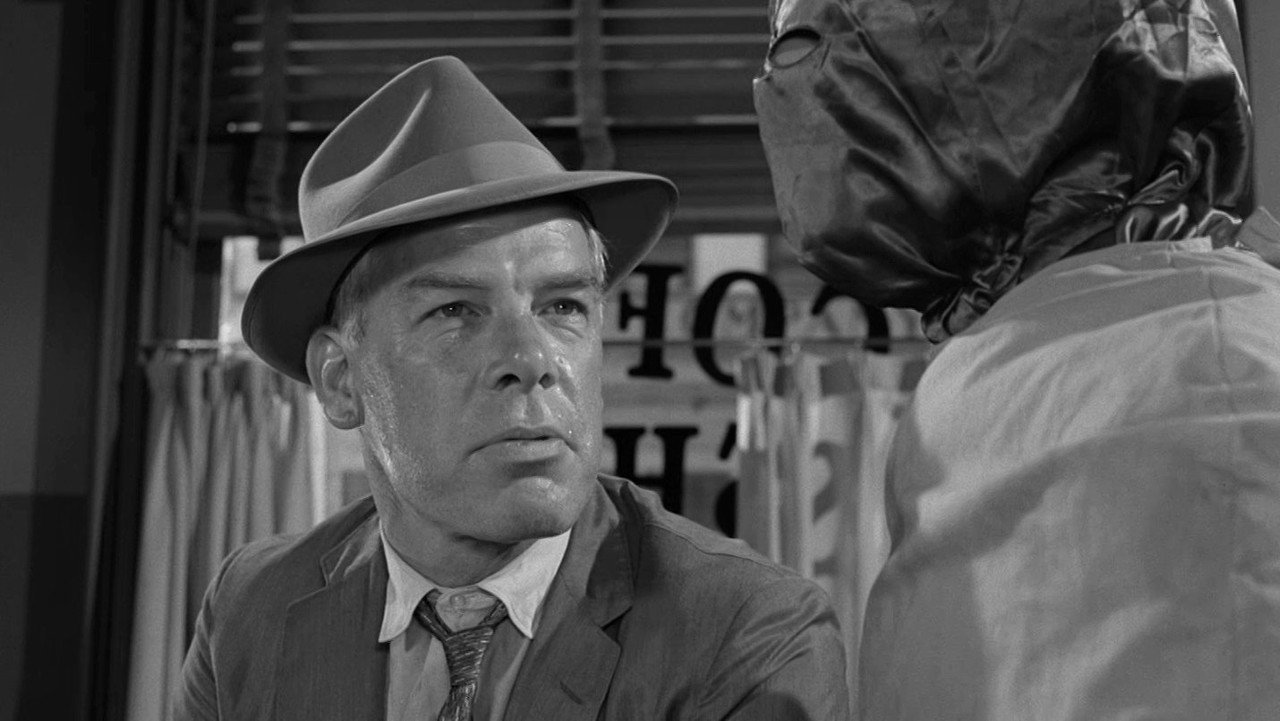
The story in 5 beats
- The future of the fight game
Boxing between people has been outlawed. Kelly and Pole have an old B2 android, Battling Maxo, booked for a fight.
- A broken spring
Maxo's arm spring fails in testing. The part isn't made anymore, and they have no spare.
- Kelly's idea
Rather than lose the $500 purse, Kelly decides to go into the ring himself, dressed as Maxo.
One roundSpoiler · tap to reveal
Kelly faces Maynard Flash, a far more advanced model. He lasts the round while the crowd boos.
Half the purseSpoiler · tap to reveal
The promoter pays $250 for a bad show. Kelly, wrecked, can't protest. He's already planning Maxo's next fight.
Why it still matters
Steel Kelly used to be a heavyweight. Then the law took humans out of the ring and put androids in, and now Kelly and his mechanic, Pole, manage an outdated robot called Battling Maxo. Maxo is falling apart, the parts are discontinued, and tonight's purse is $500. Richard Matheson wrote it from his own short story, and it's one of the plainest scripts the show ever did: two broke men, a locker room, a machine that won't work.
Lee Marvin is the reason to watch. Matheson compared Kelly to Captain Ahab, a man with one idea, and Marvin plays him as somebody who would sooner be hurt than ask for help. It's also the rare Twilight Zone about automation that cares less about the robots than about the man they've put out of work, which is why it feels newer than its 1974 future.
What Kelly wins
Kelly survives one round against Maynard Flash, barely. The crowd boos the slow robot, and the promoter, unhappy with the show, pays half of the $500. Kelly can't argue, or he'll be found out. Nearly killed, he tells Pole the money will fix Maxo, and they'll fight again.
There's no supernatural twist. The machine wins and the man gets paid less for being human, and he still won't quit. Serling's closing narration, which you're free to argue with, calls it a portrait of a losing side and argues that tenacity and optimism outlast the machinery, ending on "a unanimous decision rendered from the Twilight Zone."
Behind the scenes
- Matheson's story first appeared in the May 1956 issue of The Magazine of Fantasy & Science Fiction. The teleplay moves it from 1997 to 1974.
- Chuck Hicks, a stuntman and boxer, played Maynard Flash in a William Tuttle mask that fogged up and blocked his view. Hicks told historian Martin Grams Jr. that he hit Marvin for real "a couple of times," and that Marvin never complained.
- Matheson recalled Marvin getting into character by making crowd and street noises to himself, even though there was no set around him.
- The episode aired after Benny Paret died following his 1962 fight with Emile Griffith and Davey Moore died in 1963, and Serling's narration predicted boxing would be outlawed within five years. It never was.
- It was the first episode sponsored by Procter & Gamble, which alternated weeks with American Tobacco.
- It's Lee Marvin's second Twilight Zone, after the western "The Grave," and the only episode Don Weis directed. Matheson reportedly called it his favorite of his own episodes.
The thread
From a pulp magazine to a Hugh Jackman blockbuster, with a few cartoon robots in between.
Came before
Shares DNA with
Left its mark on
DNA strand
Technology Outpaces Ethics
The law here meant well: it took people out of a sport that was killing them. Nobody thought about the fighters who had nothing else. Matheson keeps the robots dumb and the arena seedy, so the progress feels real and the cost lands on one stubborn man.
Every great sci-fi story is built from a handful of strands like this one. Each strand page explains how it works and traces it across shows, books and films.
If this one stayed with you
Where to go next, and why.
Watch · Film
Real Steel (2011)
The same Matheson idea, scaled up into a father-and-son crowd-pleaser. Watching the two side by side shows how differently a story can treat the man in the corner.
Read · Short story
"Steel" — Richard Matheson
Matheson changed very little for television, so the story is a chance to see how much of the episode's grit was on the page from the start.
Watch · Film
Requiem for a Heavyweight (1962)
If Kelly's refusal to quit got to you, this is Serling's portrait of a fighter at the end of the line, no robots required.
Watch · Twilight Zone S3
"The Grave" (1961)
Lee Marvin's other episode: a hired gun, a dare and a night in a graveyard. He's just as good at playing a man too proud to back down.
Sources
- “Steel (The Twilight Zone),” Wikipedia
- “The Twilight Zone (1959 TV series) season 5,” Wikipedia
- “Why Twilight Zone's Lee Marvin Kept Getting Punched in the Face While Filming Classic Episode,” SYFY WIRE
- “How Lee Marvin Hyped Himself Up for This Classic Twilight Zone Episode About Boxing Robots,” SYFY WIRE
- “The Twilight Zone Episode That Inspired One Of Hugh Jackman's Best Films,” /Film
- Zack Handlen, “The Twilight Zone: "In Praise Of Pip"/"Steel",” The A.V. Club, 2014
- “The Twilight Zone: Season 5, Episode 2, Steel,” Great Books Guy