
More from the episode
The story in 5 beats
- Starbase 11
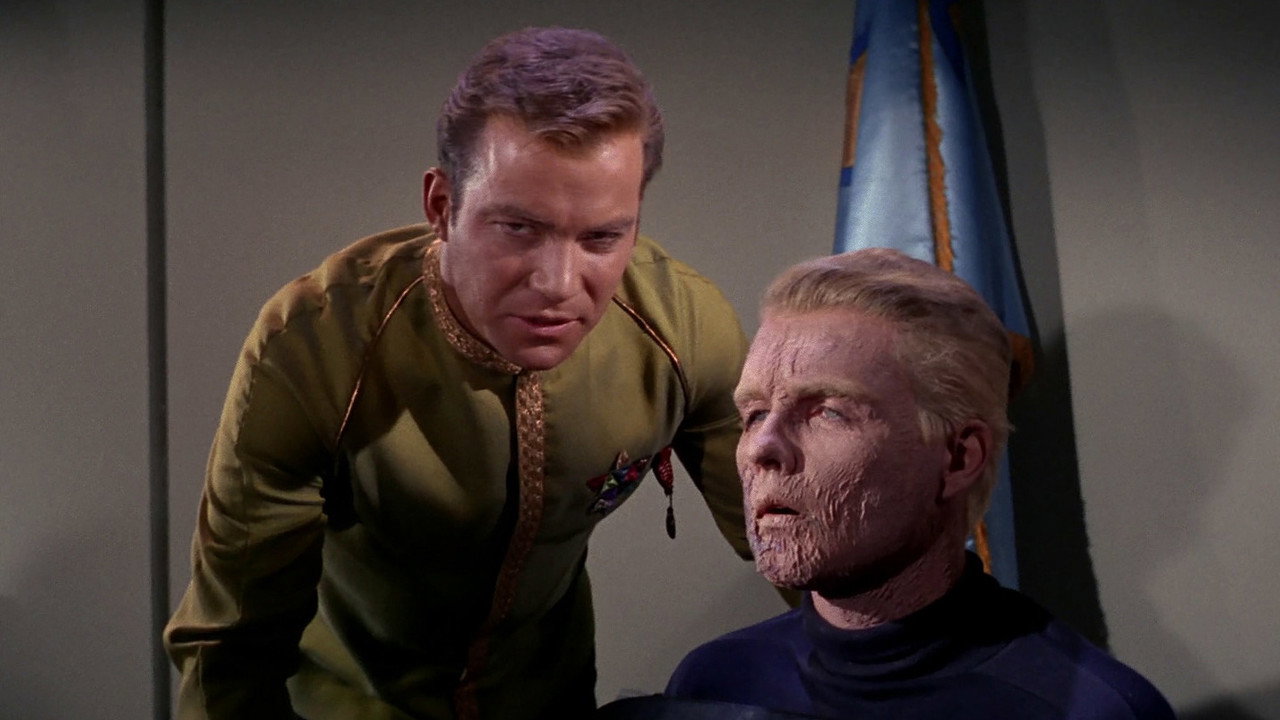
Kirk visits his injured predecessor, Captain Pike, who can no longer move and answers only yes or no. Pike wants nothing to do with Talos IV.
- Mutiny
Using faked recordings of Kirk's voice, Spock takes the Enterprise and sets course for Talos IV, with Pike aboard. Then he turns himself in.
- Court-martial
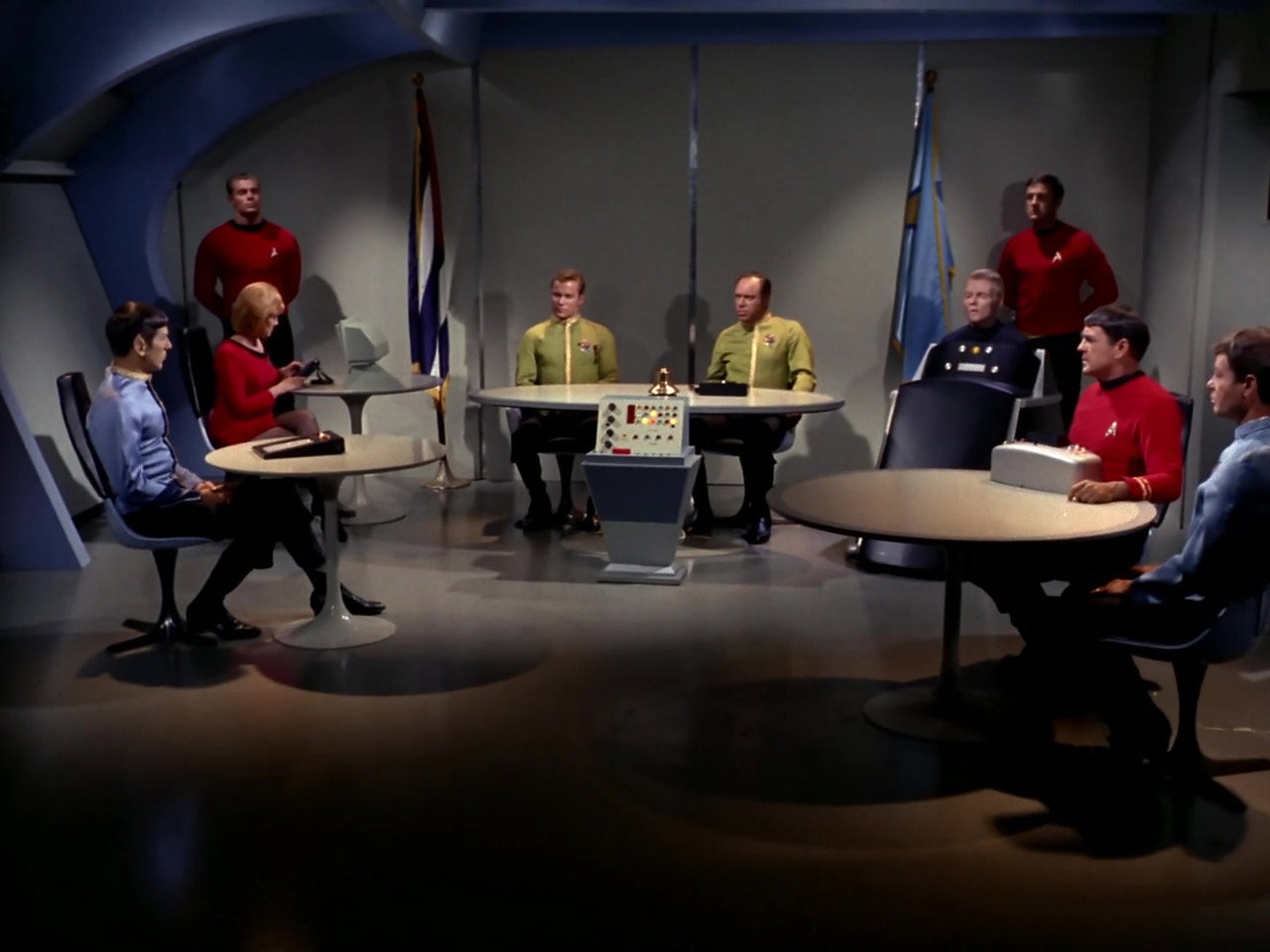
At his court-martial, with Kirk and Commodore Mendez on the bench, Spock offers his evidence: footage of the Enterprise's visit to Talos IV in 2254.
- The Cage
On the screen, a younger Pike leads a landing party on Talos IV and is taken by the Talosians, who can make anyone see anything.
The broadcastSpoiler · tap to reveal
The hearing learns that the images aren't coming from the ship's records. They're being sent from Talos IV.
Why it still matters
The Enterprise is called to Starbase 11 for a message from Christopher Pike, the ship's former captain. Pike has been terribly injured; he can't move or speak and can answer only yes or no. Then Spock, of all people, takes the ship with faked recordings of Kirk's voice and heads for Talos IV, a planet Starfleet has forbidden anyone to approach. When he's caught, he asks for a court-martial and offers his evidence: footage of what happened when Pike's Enterprise visited Talos IV thirteen years earlier.
That footage is "The Cage," the show's first pilot, which NBC had turned down and which audiences had never seen. Gene Roddenberry built a courtroom drama around it so the unaired hour could become two aired ones, and the frame works better than it has any right to. You get a different captain (Jeffrey Hunter's tired, thoughtful Pike), a different crew, and a mystery in the present about why Spock would throw away his career.
Part I is mostly setup and flashback, and it ends on a hook that makes Part II hard to put off.
A signal from the forbidden planet
The first half ends on its best trick. Everyone assumes Spock has brought a recording, but there's no recording: the pictures are reaching the Enterprise live from Talos IV. Whoever lives there is taking part in the trial, and they can project images across space. That changes the question. If the Talosians can show the court anything, then anything the court sees might be a show.
Inside the flashback, Pike's situation has turned just as strange. He's in a cell, on display to beings who read thoughts and build illusions indistinguishable from life, with a young woman named Vina who seems to know more than she says. Part I leaves Spock's reasons unexplained and Pike's fate in the old footage unresolved, which is exactly where Roddenberry wanted the audience a week before Part II.
Behind the scenes
- The series' effects were causing delays and episodes were reaching NBC later and later. Roddenberry's answer was a two-part story that needed only about a week of new filming, wrapped around footage from the unaired 1965 pilot, "The Cage."
- NBC had passed on "The Cage," reportedly finding it "too cerebral," and ordered a second pilot instead.
- Jeffrey Hunter, the pilot's Captain Pike, had chosen to focus on films, so Sean Kenney played the injured Pike in the new scenes.
- Malachi Throne plays Commodore Mendez, and through the pilot footage he also gives the voice of the Talosian Keeper. Majel Barrett, billed as M. Leigh Hudec, plays Pike's first officer, Number One.
- Only a black-and-white 16mm print of "The Cage" existed at the time, so the color footage had to be cut from the pilot's original negative. Unused color trims turned up in Los Angeles in 1987.
- Marc Daniels is credited on Part I because most of his new footage is in it; Robert Butler, who directed the pilot, is credited on Part II.
The thread
A lost pilot turned into a trial, and a captain the franchise kept coming back to.
Came before
Shares DNA with
Left its mark on
DNA strand
Is Any of This Real?
The Talosians can make anyone see anything, and once the trial learns they're involved, every image on the screen becomes suspect. It's a smart way to tell a story about illusion: the audience is watching footage too, and it has to decide how much to trust it.
Every great sci-fi story is built from a handful of strands like this one. Each strand page explains how it works and traces it across shows, books and films.
If this one stayed with you
Where to go next, and why.
Watch · Star Trek: TNG
"The Inner Light"
If Pike's cell made you wonder what you'd accept as real, Picard gets a far longer test of the same question.
Watch · Film
The Truman Show (1998)
A man in a beautifully made enclosure, watched by people who think they know what's good for him.
Read · Novel
Ubik — Philip K. Dick
Dick's best puzzle about a reality that keeps slipping, written for anyone who enjoyed not knowing which images to believe.