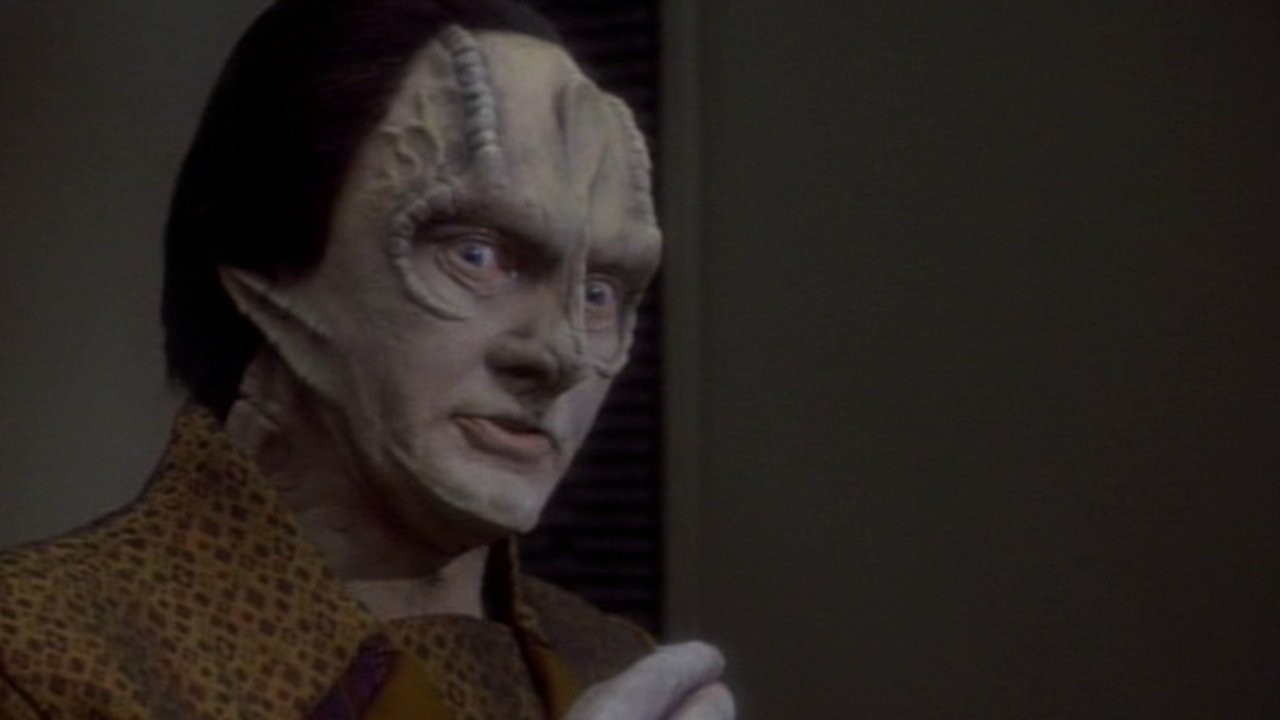
The story in 5 beats
- Lunch with Garak
At his weekly lunch with Bashir, Garak is clearly suffering from severe headaches. He refuses any help, and is later overheard arranging a quiet deal with Quark.
- Something in his head
After a night of heavy drinking, Garak collapses. In the infirmary, Bashir finds a device implanted in his brain, and Odo catches Quark trying to order a piece of classified Cardassian technology.
- The first story
Delirious and in pain, Garak starts telling Bashir about the crime that got him exiled. It's a dramatic confession, and the first of several.
What the wire doesSpoiler · tap to reveal
The implant was built to make Garak resist torture, and he has been using it to numb his exile. With it switched off, he is dying, and his story keeps changing.
Especially the liesSpoiler · tap to reveal
Bashir finds the man who put the wire in Garak's head and learns who "Elim" really is. Back at lunch, Garak says every story he told was true.
Why it still matters
Garak, the only Cardassian left on the station, began as a one-off part. Andrew Robinson has said he took the job because he needed money to pay that month's bills. The producers liked him enough to keep bringing him back, and "The Wire" is the episode where Robert Hewitt Wolfe finally sits Garak down and asks who he is. Garak answers at length. He just never answers the same way twice.
Most of it is two men in a room: Garak, in pain and cornered, and Julian Bashir, young and eager, trying to save a friend who won't let him. Siddig El Fadil and Robinson play it as a duel between people who enjoy each other's company. Zack Handlen at The A.V. Club praised how the episode shifts our view of Garak without it feeling like the writers had simply changed their minds about him, and was glad to see Bashir handed a problem worthy of his talents. In 2014 io9 ranked it 49th out of more than 700 Star Trek episodes.
It's a small, talky hour that ends up carrying a lot of the series. Later Garak stories keep coming back to the questions it raises, and to the line he leaves Bashir with at the end, which could be a joke or the most honest thing he has ever said.
All of them true
The device is Obsidian Order technology, installed by the Order's former head, Enabran Tain (Paul Dooley), to let Garak withstand torture. In exile Garak has been triggering it to cope, he's addicted, and it's failing from overuse. As Bashir weans him off it, Garak tells three stories. First, he destroyed a ship carrying 98 Cardassians, including his aide, Elim. Then, he was exiled for letting a group of Bajoran children he was meant to interrogate go free. Finally, Elim was his childhood friend and fellow Order officer, and Garak tried to frame him for releasing Bajoran prisoners, but Elim got there first.
Even with the implant off, Garak is dying, so Bashir goes to Tain himself. Tain tells him a real friend would let Garak die, but hands over what Bashir needs. As Bashir leaves, he asks what became of Elim, and Tain laughs: Elim is Garak's first name. Recovered, Garak resumes their lunches and mentions an odd rumor that Odo thinks he was once in the Obsidian Order. When Bashir asks which of the stories was true, Garak tells him they all were, especially the lies.
Challenge the DNA
Which of Garak's stories is true?
Or skip ahead to our reading
The episode won't say, and Garak certainly won't. Each story ends in betrayal and exile. Bashir's lesson is that the lie can still tell you something.
Behind the scenes
- Robert Hewitt Wolfe wrote it and Kim Friedman directed. It first aired in syndication on May 8, 1994, with Andrew J. Robinson as Garak and Ann Gillespie as Nurse Jabara.
- Robinson had been one of the final three choices to play Odo, alongside Gerrit Graham and René Auberjonois, before the role went to Auberjonois. He was brought back to audition for Garak.
- Garak was intended as a one-off character. Robinson has said he took the part because he needed the money that month; the producers liked his performance and kept developing the character once he agreed to return.
- Reviewing it for TrekNation, Michelle Erica Green credited the actors with making it work despite misgivings about the pace, and described the Bashir and Garak relationship as "flirting." Keith R. A. DeCandido gave it eight out of ten in his 2013 Tor.com rewatch, calling it a showcase for the pair.
- In 2014 io9 ranked "The Wire" the 49th best Star Trek episode, out of more than 700 made by then.
- Robinson later wrote a biography of Garak to flesh out the character, "an old actor's trick," he said. It grew into his 2000 novel A Stitch in Time, written as a letter from Garak to Bashir.
- It drew a Nielsen rating of 8.0 on first broadcast, according to the season's figures compiled by TrekNation.
The thread
Where Garak came from, the old trick of a story told several ways, and the spy fiction Robinson reached for when he wrote Garak himself.
Came before
Shares DNA with
DNA strand
Memory & Identity
Garak's three versions of his past contradict each other on the facts, and every one of them ends in betrayal and exile. The episode lets the possibility stand that the cover stories are as much Garak as anything underneath them. By the end, Bashir knows more about him than anyone on the station and can't say for certain that any of it happened.
Every great sci-fi story is built from a handful of strands like this one. Each strand page explains how it works and traces it across shows, books and films.
If this one stayed with you
Where to go next, and why.
Read · Star Trek novel
A Stitch in Time — Andrew Robinson
Garak's life told by the man who played him, written as a long letter to Bashir. If the lunches are your favorite part of this episode, this is the rest of the conversation.
Read · Novel
Tinker Tailor Soldier Spy — John le Carré
Robinson pointed to le Carré's spies when he talked about turning Garak's life into a novel. Old intelligence men, buried loyalties and nobody saying what they mean.
Watch · Film
Rashomon (1950)
Four people tell the same crime four ways. Garak manages three versions on his own.
Watch · Star Trek: DS9 S2
"Profit and Loss" (1994)
Garak a few weeks earlier, talking to Quark about clothes while meaning something else entirely, with Cardassian politics on the station's doorstep.
Your next episode
Three directions to go from here, all on Sci-Fi DNA.
More of this feeling
Cardassians
Star Trek: Deep Space Nine
Garak and Bashir's lunches, and a Cardassian mystery on the station.

Same question, different answer
The Obsolete Man
The Twilight Zone
What do you owe a state that threw you out?
Something completely different
Crossover
Star Trek: Deep Space Nine
Kira and Bashir in the Mirror Universe.
Sources
- “The Wire (Star Trek: Deep Space Nine),” Wikipedia
- “Elim Garak,” Wikipedia
- “A Stitch in Time (Robinson novel),” Wikipedia
- “List of Star Trek: Deep Space Nine episodes,” Wikipedia
- “Star Trek: Deep Space Nine Rewatch: "The Wire",” Tor.com
- “Star Trek: Deep Space Nine: "The Maquis Part II"/"The Wire",” The A.V. Club
- “The Top 100 Star Trek Episodes Of All Time!,” io9