The story in 5 beats
- Ferenginar goes quiet
Rom can't reach home and fears the Dominion has taken it. Then a ship arrives carrying Zek and Ishka, and Zek has been deposed.
- One commissioner
Quark, Rom and Nog invite all 432 Ferengi commissioners to the station to hear Zek out. Exactly one agrees to come, and Brunt turns up to gloat.
- Mother and son
Quark blames Ishka for the whole mess. The shouting match ends with her heart giving out, and Bashir has to perform a transplant.
- Lumba
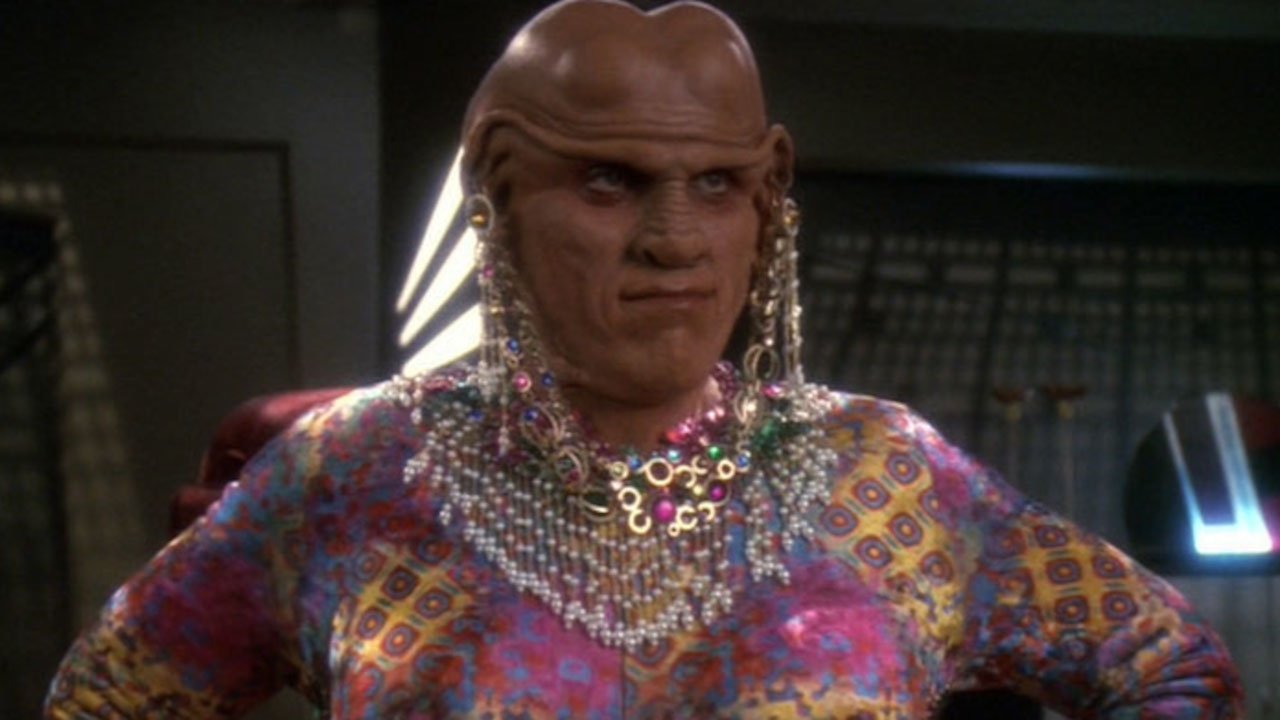
With Ishka out of action, Quark takes her place as Lumba, a Ferengi woman, to explain over dinner why clothed females mean more workers and more customers.
After dinnerSpoiler · tap to reveal
The commissioner chases Lumba around his quarters. Then Brunt bursts in, determined to expose her.
Why it still matters
For years the Ferengi episodes had been building a slow story about Ferengi women. Quark's mother Ishka made a profit when the law said females couldn't, Pel passed herself off as a man to do business, and Grand Nagus Zek fell for Ishka. "Profit and Lace" is where that story comes to a head. Zek has changed the Ferengi Bill of Opportunities so women can wear clothes, the Ferengi Alliance is in an uproar, and Liquidator Brunt is about to be installed as Nagus in his place.
It is also one of the least loved episodes of the series. When Ishka can't speak for herself, Quark has his body altered to take her place as a Ferengi woman, and much of the hour goes on the comedy around that: Rom coaching him on how to move, a lecherous commissioner, Brunt sniffing around. Some fans and critics count it among the show's worst. Wired's 2015 binge-watching guide said to skip it, and CBR put it on a 2018 list of Star Trek episodes "so bad they must be seen." SyFy Wire was kinder in 2016, listing it among the franchise's most hated episodes that deserve a second chance.
Alexander Siddig, who plays Bashir, directed it, his second time behind the camera after "Business as Usual" in 1997. Henry Gibson plays Nilva, the commissioner everyone is trying to win over.
Lumba makes the sale
Brunt tries to unmask Lumba as an impostor and a man. It falls apart when Lumba takes off her dress: Quark's body really has been changed, and Brunt and the commissioner can see she is physically a woman. The commissioner, convinced, pledges his support for Zek.
Quark's change is reversed, and Zek and Ishka leave the station expecting Zek to be restored as Nagus. Quark apologizes to his mother, and she accepts: he was a lousy son, she tells him, but he made a wonderful daughter. Then he apologizes to the waitress he harassed in the opening scene and gives her a raise.
Challenge the DNA
Did Quark learn anything?
Or skip ahead to our reading
He apologizes to his mother and to the waitress he harassed, and gives her a raise. Ishka tells him he made a wonderful daughter. It's a small change, and the episode settles for that.
Behind the scenes
- Written by showrunner Ira Steven Behr and Hans Beimler, and directed by Alexander Siddig, who had also directed "Business as Usual" in 1997.
- Henry Gibson plays Nilva, the one commissioner who comes. Wallace Shawn is back as Grand Nagus Zek, Jeffrey Combs as Brunt and Cecily Adams as Ishka.
- For Ishka's first trip off Ferenginar, Cecily Adams wore a Spandex suit from her wrists to the tips of her toes.
- Nadja Sennewald, writing about the show's gender-swap episodes in the book Alien Gender, notes that this one presents Rom as the expert on 'female' movement, far better suited to imitating a woman than Quark, who actually has to do it.
- It drew a Nielsen rating of 4.2.
- Its reputation is mixed at best: Wired (2015) recommended skipping it, CBR (2018) called it one of the Star Trek episodes "so bad they must be seen," and SyFy Wire (2016) argued it deserved a second chance.
The thread
The earlier Ferengi episodes that set up Zek, Ishka and the rules about women, and the older comedies about a man in disguise.
Came before
Shares DNA with
DNA strand
Sci-Fi Played for Laughs
The Ferengi episodes were Deep Space Nine's comedies about money, aimed at a culture that treats greed as a virtue and has strict rules about what women may do. This one makes its case for equal rights through a broad farce, with Quark arguing for Ferengi women while living as one.
Every great sci-fi story is built from a handful of strands like this one. Each strand page explains how it works and traces it across shows, books and films.
If this one stayed with you
Where to go next, and why.
Watch · Star Trek: DS9 S2
"Rules of Acquisition" (1993)
The same question from the other side: a Ferengi woman who has to pass as a man just to be allowed to trade.
Watch · Star Trek: DS9 S5
"Ferengi Love Songs" (1997)
Zek and Ishka at home on Ferenginar, with Brunt scheming. The best background for this episode's politics.
Watch · Film
Tootsie (1982)
A man in disguise who finds himself speaking up for women. The same setup, played as a romantic comedy.
Read · Novel
The Left Hand of Darkness by Ursula K. Le Guin
An envoy on a planet whose people have no fixed sex, who can't stop sorting them into men and women. A serious take on what this episode plays for laughs.
Your next episode
Three directions to go from here, all on Sci-Fi DNA.
More of this feeling
Ferengi Love Songs
Star Trek: Deep Space Nine
Quark, Ishka and the Nagus in an earlier scheme.
Same question, different answer
Family Business
Star Trek: Deep Space Nine
What does Ferengi society say about women?
Something completely different
Time's Orphan
Star Trek: Deep Space Nine
A family picnic, an ancient portal, and a lost daughter.
Sources
- “Profit and Lace,” Wikipedia
- “Ishka,” Wikipedia
- “Alexander Siddig,” Wikipedia
- “Rom (Star Trek),” Wikipedia
- “List of Star Trek: Deep Space Nine episodes,” Wikipedia
- Michelle Erica Green, “Retro Review: Profit and Lace,” TrekToday, 2014
- Graeme McMillan, “WIRED Binge-Watching Guide: Star Trek: Deep Space Nine,” Wired, 2015